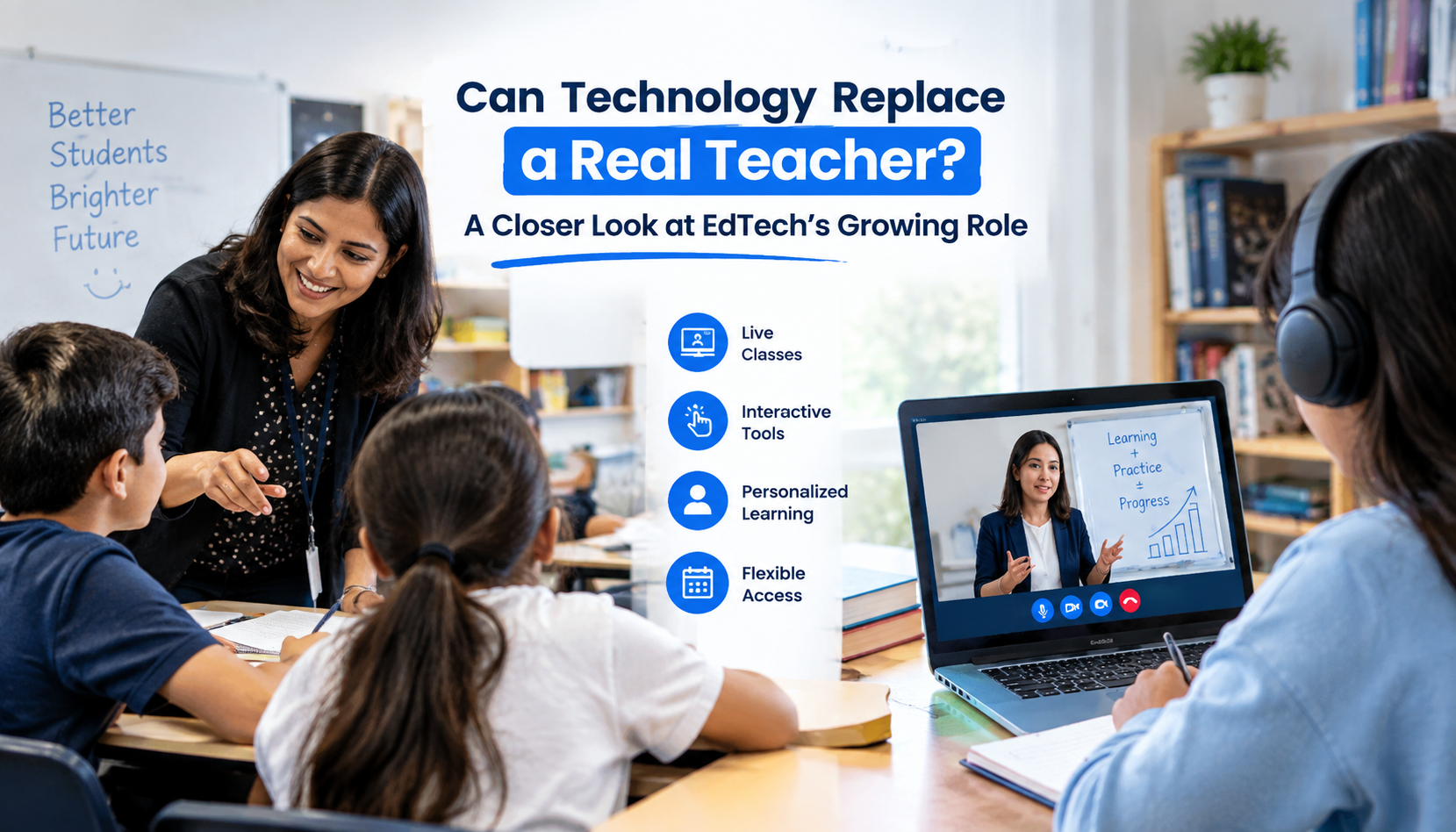
Can Technology Replace a Real Teacher? A Closer Look at EdTech's Growing Role
How teachers and technology can work together to create a more personalized and effective learning experience.
Millions of students now do most of their learning through a screen. Almost nobody stopped to ask, seriously, whether that made them any smarter — or just made education a lot easier to sell.
Ask ten people whether online learning actually works, and you'll probably get ten different answers, most of them based on a gut feeling rather than anything they've actually read. Some people swear by it. Others roll their eyes and say nothing beats sitting in front of a real teacher. And honestly, until fairly recently, there wasn't a huge pile of solid research either side could point to.
That's changed. There's real data now — years of it, across millions of students — and a pretty clear picture is finally starting to form. The answer isn't a clean yes or a clean no, though. It's messier than that, and a bit more interesting too: the technology only ever turns out to be as good as what's actually built around it.
“Everyone kept asking whether online learning works. The better question was always which kind of online learning, and for whom.”
Stick with that question for a minute, because it's really the whole story hiding underneath the headlines.
The Explosion Nobody Fully Planned For
Online education didn't creep up slowly. It exploded almost overnight, at a moment when millions of students around the world suddenly had no other option but a laptop screen and a shaky internet connection. What had been a quiet, gradual trend turned into the default in a matter of weeks, and an entire industry scrambled to catch up with demand nobody had properly planned for.
In the years since, things haven't really slowed down. Video courses, AI-powered practice apps, virtual classrooms, and online tutoring platforms have multiplied faster than most traditional education systems know how to respond to. For a while there, almost any tool with the word “online” in its name could find eager customers, mostly because the alternative felt so limited by comparison.
That early gold-rush phase is mostly over now, and honestly, that's a good thing. What's left is a far more competitive, far more scrutinised industry — one where students and parents have finally started asking the harder, more useful question: does this specific tool genuinely help someone learn, or does it just look impressive in a slick demo video?
It's worth remembering just how unusual that early period really was. Entire school systems, universities, and corporate training programs rebuilt themselves around video calls and learning apps in a matter of weeks, not years. Nobody had time to properly test what actually worked before rolling it out to millions of people at once. Most of what we now understand about online learning's real strengths and weaknesses only became clear afterward, once researchers finally had enough genuine, messy, real-world data to dig through.
What the Research Actually Shows
Strip away the marketing language, and a fairly consistent pattern shows up again and again across independent studies on online learning. Passive formats — pre-recorded lectures, static reading modules, self-paced courses with almost no interaction — tend to produce noticeably weaker results than in-person classroom learning. That gap shows up especially clearly with younger students, and with subjects that build on themselves step by step, like maths and the sciences, where missing one small piece early on quietly wrecks everything that comes after it.
But active, interactive formats tell a completely different story. Live sessions with real-time feedback, small-group instruction, and especially one-on-one tutoring delivered over video call, consistently perform just as well as traditional classroom teaching — and in some specific situations, noticeably better.
The real difference was never actually about whether a lesson happens on a screen or in a room. It's about whether an actual person is watching how the student responds, and adjusting in real time because of it. That single factor shows up over and over as the strongest predictor of whether online learning genuinely sticks, or quietly slides off a student without them even realising it.
Age matters here too, more than most marketing pages ever admit. Older students and working adults, who usually already have clear goals and stronger self-discipline, tend to do genuinely well with self-paced online courses on their own. Younger students, still building the habit of studying without a physical person standing there keeping them on track, tend to need a lot more structure and real human interaction before that same self-paced format works anywhere near as well for them.
Where the Technology Genuinely Earns Its Praise
None of this means the technology deserves the blame every time something goes wrong. In plenty of very real ways, it's done exactly what it originally promised, and it deserves credit for that.
Students living in small towns or remote areas now have access to specialised tutors and advanced courses that simply didn't exist anywhere nearby before. Parents juggling long work hours can finally fit lessons into whatever narrow window actually works for their family, instead of being locked into a fixed school timetable that assumes someone's always free at 4 p.m. Students who learn a little faster, or a little slower, than the rest of their class can finally move at their own pace instead of being stuck exactly in the middle of the room, bored or lost depending on the day.
AI-powered tools have added something genuinely useful on top of all that — instant practice questions, patient explanations repeated in five different ways, and help available at two in the morning when no tutor or teacher on earth is awake to answer a question. Used as a supplement alongside real teaching, these tools measurably help. Used as a full replacement for an actual human being, the research is a lot less convincing, and honestly, a lot less common in the platforms that actually get results.
Cost deserves a mention here too, because it's easy to overlook. A student who once had to pay a small fortune for in-person coaching, travel time included, can often access equally strong instruction online for a fraction of that price. That single shift alone has quietly opened doors for families who were priced out of decent tutoring entirely, just a few years ago.
Where It Quietly Falls Apart
The weak point was never really the technology's raw capability. It's what happens the moment nobody is paying attention to whether that technology is actually working for one specific, real student sitting in front of it.
Self-paced courses have famously low completion rates, and it's not because the material is too hard. It's because motivation fades fast the moment there's no one around to notice when a student quietly stops showing up. A pre-recorded video has no way of telling when a student is nodding along politely without actually understanding a single word of what just happened. And a chatbot, however impressively it's been built, still struggles badly to notice the exact moment a student goes quiet out of embarrassment rather than genuine confusion — something a decent human tutor tends to catch almost instantly, often without the student saying a word.
These aren't small bugs waiting patiently for the next software update to fix them. They're structural gaps that show up the moment you remove a responsive human being from the process, and no amount of better animation, smoother interface design, or clever gamification closes that particular gap on its own.
There's an easy way to see this pattern play out for yourself, if you're curious. Compare a free video course sitting on a popular learning platform, watched by tens of thousands of people, against a small, live class of five or six students working through the same material with an actual instructor guiding them. The video course will almost always rack up far more sign-ups. The live class, again and again, tends to produce far more people who genuinely finish it and actually remember what they learned six months later. Attention, not access, keeps turning out to be the far harder problem to solve.
The Model That Keeps Outperforming Everything Else
Put all of this together, and one particular model keeps coming out on top, study after study: technology used to make a real tutor easier to reach, rather than technology quietly trying to replace one altogether.
In practice, that looks like live, one-on-one or small-group instruction, delivered over video call or in person, where a platform quietly handles the scheduling, the matching, and all the annoying logistics in the background — while a real, actual person is still doing the teaching itself. Watching for confusion. Adjusting explanations on the fly. Pushing a student exactly as hard as they can handle on that particular day, and pulling back the moment it's clearly too much.
It's a model that borrows the best of both worlds instead of stubbornly picking a side. The technology quietly removes the old, practical barriers — distance, scheduling conflicts, a shortage of genuinely good tutors in any one location. The human being keeps hold of the part that actually makes a lesson land in the first place: noticing, adjusting, encouraging, and knowing exactly when to slow down, speed up, or just sit with a student for an extra five minutes because today happened to be a harder day than usual.
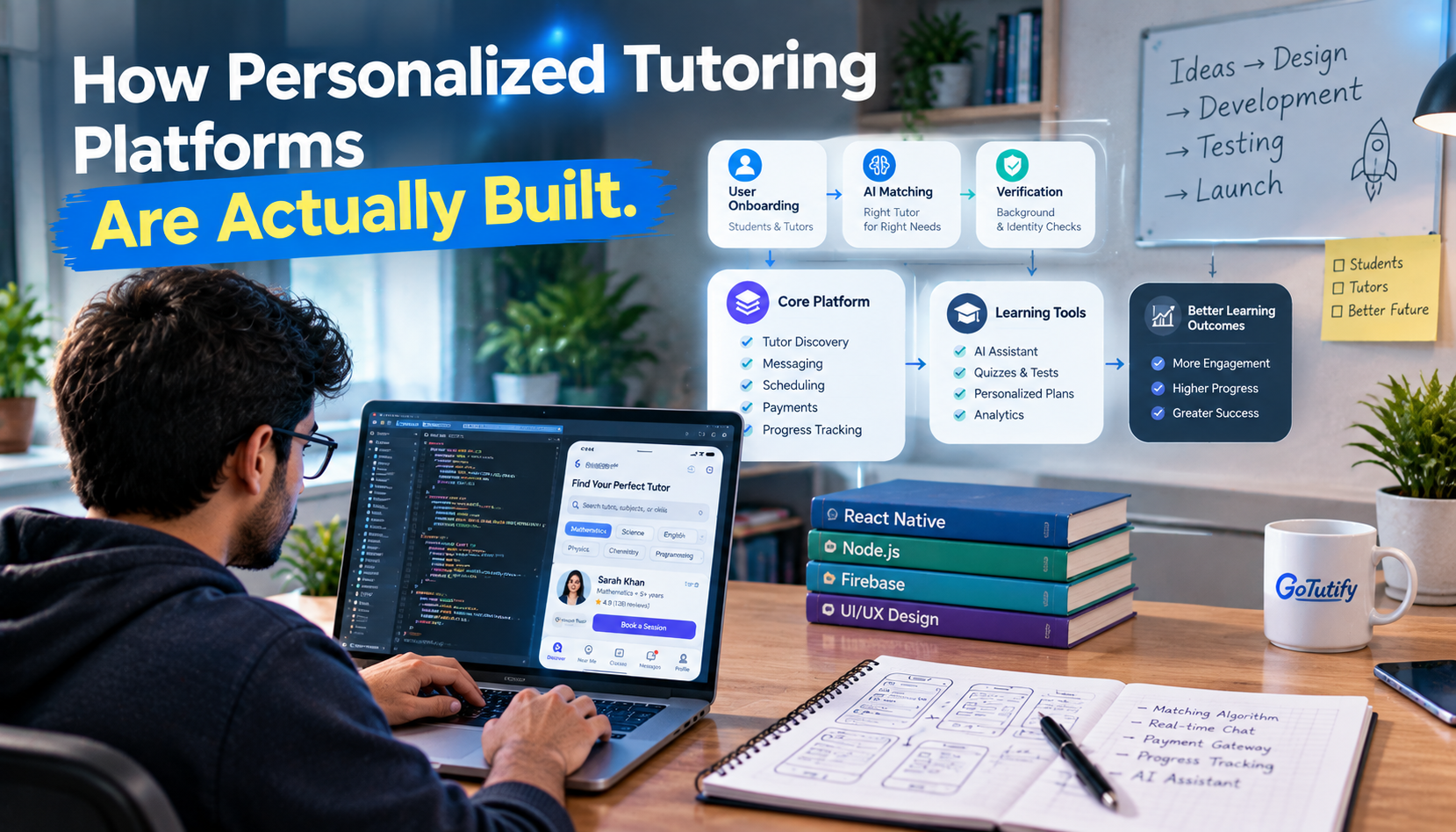
It's the same basic idea behind platforms like GoTutify, which lean on technology to connect students with real tutors quickly and easily, rather than trying to quietly replace the tutor altogether. The software handles the part that's genuinely annoying — finding the right person, at the right time, for the right subject, without weeks of back-and-forth messaging. The human being still handles the part that actually matters: the teaching itself.
It's worth sitting with that distinction for a second, because it's easy to miss on a first read. A lot of platforms out there are trying to build the smartest possible AI tutor, one that never gets tired, never needs a break, and can theoretically teach an unlimited number of students at once. GoTutify, and platforms built around a similar philosophy, are quietly betting on something a little less flashy but a lot more grounded: that the best use of all this new technology isn't replacing the human in the room; it's simply making it easier for a student to find the right one.
So, Is It Actually Working?
The honest, slightly unsatisfying answer is: it depends entirely on which version of it you happen to be using.
If online learning means a student sitting alone with a pre-recorded video and absolutely nobody checking in on them, the evidence suggests it's a weaker substitute for real teaching, not an upgrade on it. If it means a live, responsive tutor reaching a student who otherwise had no access to one at all, the evidence points firmly in the other direction — often quietly outperforming a crowded, one-size-fits-all classroom that was never really built with that one specific student in mind.
The technology itself was never really the whole story here. It's just the delivery system, however impressive it looks on a homepage. What actually decides whether it works is the exact same thing that's always decided whether learning works, long before any of this technology even existed: whether there's a real, attentive person on the other end who notices, adjusts, and genuinely cares whether the lesson actually landed.
For anyone trying to pick between the dozens of platforms currently competing for their attention and their money, that's probably the single most useful filter available, and it costs nothing to apply. Skip past the flashy homepage and the impressive feature list for a moment, and just ask one plain, simple question instead: once I actually sign up, is a real, responsive human being going to be teaching me, or am I mostly going to be left alone with a very polished video library and a login page?
Platforms like GoTutify are betting, quite deliberately, that the answer to that question is exactly what most students and parents actually want, once all the marketing noise gets stripped away — a real person, made easier to find and easier to reach, with the technology quietly doing its job in the background instead of trying to steal the spotlight.
Online learning isn't succeeding or failing as one single thing. It's succeeding wherever it still makes room for a real teacher, and quietly struggling everywhere it tried to remove one.